
Snakes in Spain: All 13 Species and Which Are Venomous
Snakes in Spain: all 13 mainland species, the five venomous ones, where you actually meet them, bite first aid, dogs, and the Canary and Balearic islands.
Quick Answer
Spain has 13 mainland snake species. Only five are venomous, and only three vipers – Vipera aspis, Vipera latastei and Vipera seoanei – can seriously hurt an adult. Bites are rare, deaths average under one a year, and hospitals stock antivenom.
Key Takeaways
- Thirteen snake species live on mainland Spain: three vipers and ten colubrids, of which only five carry venom at all
- The three vipers are short, thick, blunt-tailed and have a vertical pupil - every long, slim, fast snake with a round pupil is harmless to you
- Peak season is May to July; by August snakes have shifted to dawn, dusk and night to avoid the heat
- If bitten: stay still, immobilise the limb, remove rings, call 112 - never a tourniquet, never a cut, never ice
- Dogs take viper bites on the face and swell fast; that is a same-hour veterinary emergency
- The Canary Islands have no native snakes at all - the California kingsnake there is an escaped pet turned invasive predator
Spain has more snakes than most residents realise and fewer dangerous ones than most residents fear. Thirteen species live on the mainland. Five have venom. Three of those, the vipers, are the only ones that put people in hospital, and even then the Spanish average is roughly 50 to 150 hospital-treated viper bites a year across a country of 48 million people, with deaths so rare that a fatality makes the national news. You are meaningfully more likely to be hurt by a wasp or by driving to the beach than by anything with scales.
This guide covers all 13 species, the five venomous ones ranked by how much they can actually hurt you, the specific places you meet snakes on a Spanish property, exactly what to do after a bite, dogs, garden prevention, and the very different situation on the Canary Islands and the Balearics.
What Snakes Live in Spain? All 13 Species
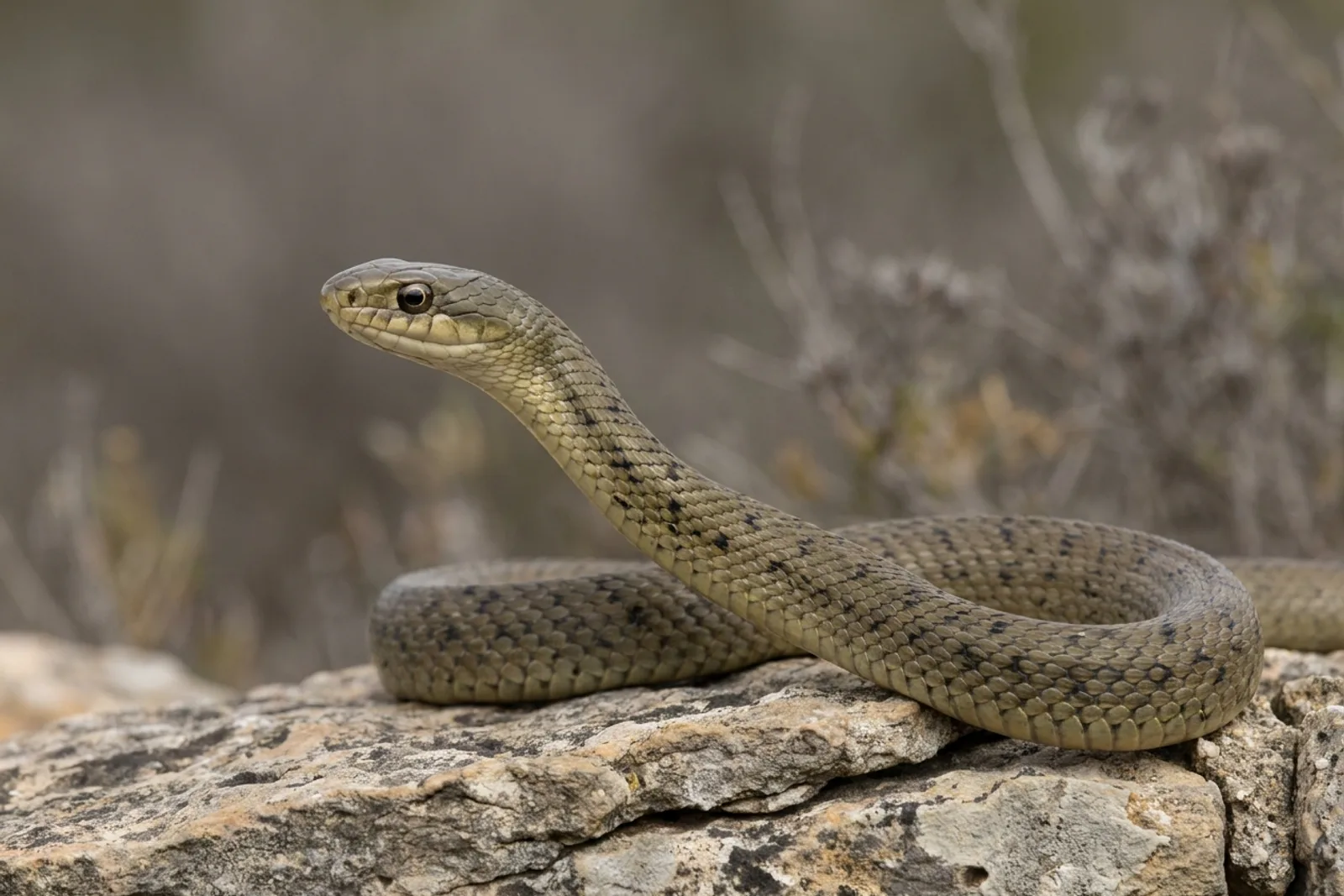
Ten of the thirteen are colubrids, the classic long, slim, quick snakes that flee the moment they feel your footsteps. Three are vipers, and vipers look different: short and heavy for their length, with a triangular head, a stubby tail that narrows abruptly, and a vertical cat-like pupil rather than a round one.
| Common name | Latin name | Venomous | Adult size | Main regions |
|---|---|---|---|---|
| Asp viper | Vipera aspis | Yes, dangerous | 50-75 cm | Pyrenees, Catalonia, Navarre, north-east |
| Lataste’s viper | Vipera latastei | Yes, dangerous | 50-70 cm | Central, southern and western Spain, Andalucia, Extremadura |
| Seoane’s viper | Vipera seoanei | Yes, dangerous | 45-65 cm | Galicia, Asturias, Cantabria, Basque Country |
| Montpellier snake | Malpolon monspessulanus | Yes, rear-fanged, mild | 120-200 cm | Nationwide, especially the dry south and east |
| False smooth snake | Macroprotodon brevis | Yes, rear-fanged, negligible | 35-50 cm | Andalucia, southern Extremadura, southern Portugal border |
| Horseshoe whip snake | Hemorrhois hippocrepis | No | 100-150 cm | Southern and eastern Spain, Ibiza, Formentera, Mallorca |
| Ladder snake | Zamenis scalaris | No | 100-140 cm | Most of the mainland, common in the Mediterranean strip |
| Aesculapian snake | Zamenis longissimus | No | 100-160 cm | Northern strip, Pyrenees, Cantabrian range |
| Western whip snake | Hierophis viridiflavus | No | 100-130 cm | Extreme north-east Catalonia only |
| Smooth snake | Coronella austriaca | No | 50-70 cm | Northern mountains, Pyrenees, Iberian System |
| Southern smooth snake | Coronella girondica | No | 50-65 cm | Widespread, mostly hills and scrub |
| Viperine snake | Natrix maura | No | 60-90 cm | Nationwide near water: rivers, acequias, ponds, pools |
| Iberian grass snake | Natrix astreptophora | No | 80-120 cm | Nationwide near water, more common in the north |
Two entries on that table cause most of the panic calls. The viperine snake (Natrix maura) is named for a reason: it has a zigzag back pattern, it flattens its head into a triangle when threatened, and it hisses convincingly. It is completely harmless and it is the snake people find in swimming pools. The ladder snake (Zamenis scalaris) is the long grey-brown snake that crosses country roads and gets killed for nothing.
The Five Venomous Snakes in Spain, Ranked
Venomous does not mean dangerous. Two of these five have fangs at the back of the mouth and a bite mechanism designed for lizards, not for a hand.
1. Lataste’s viper (Vipera latastei) – highest real-world risk
Danger rating: high. This is the viper most Spanish residents will ever be near, because it covers the centre, west and south, including Andalucia and Extremadura, exactly where the villas, fincas and campo walking routes are. It is small, 50 to 70 cm, sandy to grey with a dark zigzag along the back and a distinctive upturned snout scale. It is a sit-and-wait ambush hunter, which is why bites usually happen when a hand goes into a wall gap or a foot lands beside a basking snake. Bite effect is rapid local pain, swelling that spreads up the limb over hours, bruising, nausea, and in a minority of cases a drop in blood pressure. Hospital treatment; antivenom where the swelling progresses.
2. Asp viper (Vipera aspis) – most potent venom
Danger rating: high. Restricted to the north-east: the Pyrenees, the Catalan pre-Pyrenees, Navarre and a slice of Aragon, mostly above 700 metres. Its venom is the most medically significant of the three Spanish vipers and it is the species behind most serious European viper envenomations. Same picture as above but typically faster and more severe, with a higher rate of systemic symptoms. Hikers, not homeowners, are the exposed group.
3. Seoane’s viper (Vipera seoanei) – the wet north
Danger rating: moderate to high. Galicia, Asturias, Cantabria and the Basque Country, in green, damp, cool habitat that people rarely associate with snakes. Often darker and more contrastingly marked than its southern cousins, sometimes almost uniformly brown. Bites are less frequent than Lataste’s simply because the population density of both people and vipers is different, but the clinical response is the same: hospital, observe, antivenom if it progresses.
4. Montpellier snake (Malpolon monspessulanus) – big, fast, barely relevant
Danger rating: low. This is the giant of the list, regularly two metres, thick-bodied, grey-green, with a hard-eyed look from prominent brow ridges. It is venomous, but the fangs sit at the back of the jaw and it must chew to deliver anything. Human bites are almost always defensive nips from a snake being handled, and produce local swelling, tingling and occasionally mild numbness that resolves in a day or two. Leave it alone and there is no story. It is also a serious rodent predator, which makes it a genuine asset around a finca.
5. False smooth snake (Macroprotodon brevis) – cannot realistically hurt you
Danger rating: negligible. A small, secretive, nocturnal southern snake, rarely over 50 cm, with a dark collar behind the head. Rear-fanged, venom tuned for lizards, mouth too small to engage a human hand meaningfully. Documented human effects amount to slight local irritation.
The one identification rule worth memorising
Vipers are short, fat and blunt. Colubrids are long, slim and taper to a fine tail. If the snake is over a metre and moving fast, it is not a viper. If it is under 75 cm, thick for its length, and stayed put while you approached, treat it as one and walk away.
Where You Actually Meet Snakes in Spain
Sightings cluster in a handful of very predictable places.
Golf courses. Irrigated grass in dry country concentrates frogs, rodents and lizards, and the rough beside the fairway is warm, undisturbed cover. Montpellier snakes and ladder snakes are common on courses across Andalucia and the Costa Blanca. Retrieving a ball from long rough by hand is the single most avoidable risk in Spanish golf.
Dry stone walls and bancales. The terraced retaining walls that hold up half the Spanish countryside are perfect snake habitat: sun-warmed stone, deep crevices, and a resident population of lizards and mice. They are also where scorpions in Spain live, and the same behaviour protects you from both. Never put an ungloved hand into a wall gap you cannot see into.
Pool pump rooms and filter housings. Cool, dark, damp, mouse-friendly and usually left unopened for weeks. Viperine snakes and grass snakes end up here and in the pool itself, where they cannot climb the smooth wall to get out. A drowning snake in a pool is almost always Natrix maura and can be lifted out with a leaf net.
The campo at dawn and dusk in summer. In May and June snakes bask openly in the middle of the day. By late July, surface temperatures force them to shift activity to the two hours after sunrise and the two after sunset. Walking a dry riverbed or a track at dusk in August is a far higher-contact activity than the same walk at 2pm.
Garages, sheds and under stored garden furniture. Anywhere a small animal can get under something and stay hidden.
What to Do If a Snake Bites You
Most viper bites in Spain happen to hands and feet, and roughly a quarter are dry bites with no venom injected. The response is the same either way, because you cannot tell at the time.
- Move away from the snake, then stop moving. Get out of striking range, sit down. Do not chase it, do not try to kill it, do not photograph it up close. A description is enough.
- Call 112. Say a viper bite is suspected and give your location precisely. On rural tracks, give the nearest kilometre marker or a pinned location.
- Immobilise the bitten limb in a comfortable position, roughly at or below heart level. Splint it if you can. Movement pumps venom through the lymphatic system.
- Remove rings, watches, bracelets and tight boots immediately. Swelling can be dramatic and a ring left on a swelling finger becomes a surgical problem.
- Mark the leading edge of the swelling with a pen and write the time. Repeat every 15 minutes. This is genuinely useful information for the hospital.
- Keep the person calm and still, and let someone else drive. Do not drive yourself.
- Go to urgencias. Spanish hospitals hold viper antivenom, and the decision to give it is based on how the swelling and blood results progress, not on the bite alone.
Do not: apply a tourniquet or any tight band, cut the wound, suck the venom, apply ice, apply heat, give alcohol, or use a commercial venom extractor pump. Every one of these makes outcomes worse, and the tourniquet is the classic mistake that turns a treatable bite into tissue loss.
Rear-fanged bites from a Montpellier or false smooth snake need washing with soap and water, a clean dressing, and a check that tetanus cover is current. Watch for spreading swelling; if it spreads, treat it as above. Unsure what bit you? The bite identifier walks through the marks that distinguish a snake bite from an insect one.
Snakes and Dogs
Dogs get bitten more often than people, and worse. A dog investigates a snake nose-first, so the bite lands on the muzzle, lip or tongue, where swelling threatens the airway, and a 12 kg terrier receives a dose sized for a 60 kg adult.
Signs are fast: sudden yelp, two puncture marks, rapid facial or limb swelling, drooling, panting, weakness, pale gums, sometimes collapse. Carry the dog rather than letting it walk, keep it quiet, do not apply anything to the wound, and get to a vet the same hour. Phone ahead so they can prepare, because not every rural Spanish clinic keeps antivenom on the shelf and they may need to send for it. Hunting dogs, terriers and any dog worked through scrub in May and June are the high-risk group. Snake-aversion training courses run in Andalucia and Extremadura before the hunting season and are worth the money for a working dog.
How to Keep Snakes Out of Your Garden
Snakes come for food and cover. Remove both and they move on. Nothing else works.
- Cut and keep grass short within the perimeter you actually use. Long grass gives a snake cover to cross open ground.
- Control rodents. A snake in a garden usually means mice in a garden. This is the highest-leverage single change.
- Clear the hiding places: log piles, rubble, stacked roof tiles, old sacks, plant pots turned upside down, and gaps at the base of dry stone walls within three metres of the house.
- Lift the woodpile onto a metal rack 30 cm off the ground, so nothing can nest under it.
- Seal entry points: gaps under garage and shed doors, vents into the pool pump room, and holes around pipe penetrations. A snake needs less space than you expect.
- Keep water features and irrigation leaks under control. Frogs bring Natrix.
- Do not bother with repellent granules or ultrasonic stakes. There is no credible evidence that either deters snakes, and money spent on rodent control does more.
If a snake is already inside, open a door to the outside, clear the room, and leave it a straight escape route. It wants out more than you want it out. For a snake you cannot move safely, the local Guardia Civil SEPRONA unit or the regional agentes de medio ambiente will handle it. Every Spanish reptile species is protected under national law, so killing one is both unnecessary and potentially an offence.
Snakes in the Canary Islands and the Balearics
The islands are a completely different story from the mainland.
The Canary Islands have no native snakes. None of the seven islands evolved with one. What they now have is an invasion: the California kingsnake (Lampropeltis californiae), an escaped and released North American pet trade species, established on Gran Canaria since the late 1990s and now the subject of a permanent regional control programme, with further detections and control efforts on Tenerife and Fuerteventura. It is not venomous and it is not a danger to people. It is a constrictor eating its way through the endemic Gran Canaria giant lizard, skinks and geckos that have no evolved defence against it, which is why the Canary authorities pay for captures and ask residents to report every sighting rather than relocate the animal themselves. If you live or holiday on Tenerife, a snake sighting is a thing to report, not a thing to fear.
The Balearics have three snakes, and the natives are arguable. Mallorca and Menorca hold the false smooth snake (Macroprotodon mauritanicus), the viperine snake (Natrix maura), and the horseshoe whip snake (Hemorrhois hippocrepis). The horseshoe whip snake is a large, handsome, harmless black-and-yellow constrictor that reached the islands in the root balls of imported mature olive trees, and it has spread aggressively on Ibiza and Formentera, where it is driving the endemic Pityusic wall lizard toward extinction on parts of its range. On Mallorca it is now widely established too, and its rapid spread there is the subject of its own dedicated guide to snakes in Mallorca, including what to do if one turns up in your pool. There are no vipers anywhere in the Balearics or the Canaries. A snake bite on either archipelago is a wound-care problem, not a venom problem.
The Honest Risk Picture
Spain kills more of its snakes than its snakes kill of anyone. Across a normal year the country records a few dozen to a couple of hundred hospital-treated viper bites and, in most years, zero deaths. Compare that with the processionary caterpillar season, which reliably sends hundreds of dogs to emergency vets every spring, or the tiger mosquito now established along the whole Mediterranean coast.
The practical version: look before you put a hand or foot where you cannot see, wear real boots in the campo rather than sandals, keep dogs on a lead through scrub in May and June, and leave every snake you meet alone. Do that and the thirteen species of snakes in Spain are a wildlife-watching opportunity rather than a hazard. And if it is not a snake worrying you but something smaller in the walls, the guide to spiders in Spain covers the other residents of the same dry stone.
Frequently Asked Questions
Are there venomous snakes in Spain?
How many snake species live in Spain?
What should I do if a snake bites me in Spain?
When are snakes most active in Spain?
Are snakes in Spain dangerous to dogs?
How do I keep snakes out of my Spanish garden?

Written by James Thornton
Founder & Lead Writer
British expat living in Málaga since 2019. Researched 200+ pest control cases across 16 Spanish regions.

Reviewed by Carlos Ruiz Martín
ROESBA-certified (Spain's Official Pest Control Registry). DDD specialist. Member of ANECPLA.
Related Guides
Scorpions in Spain
Buthus occitanus and the other stinging species that share the same dry stone walls.
Spiders in Spain
Which Spanish spiders bite, which are harmless, and how to tell them apart.
Snakes in Mallorca
No vipers on the island, but the horseshoe whip snake invasion explains the sightings.