
Stink Bugs in the House in Spain: October Invasion Guide
Brown marmorated stink bugs pour into Spanish homes every October to overwinter. How to identify them, why they smell, and how to remove them without the stench.

By James Thornton
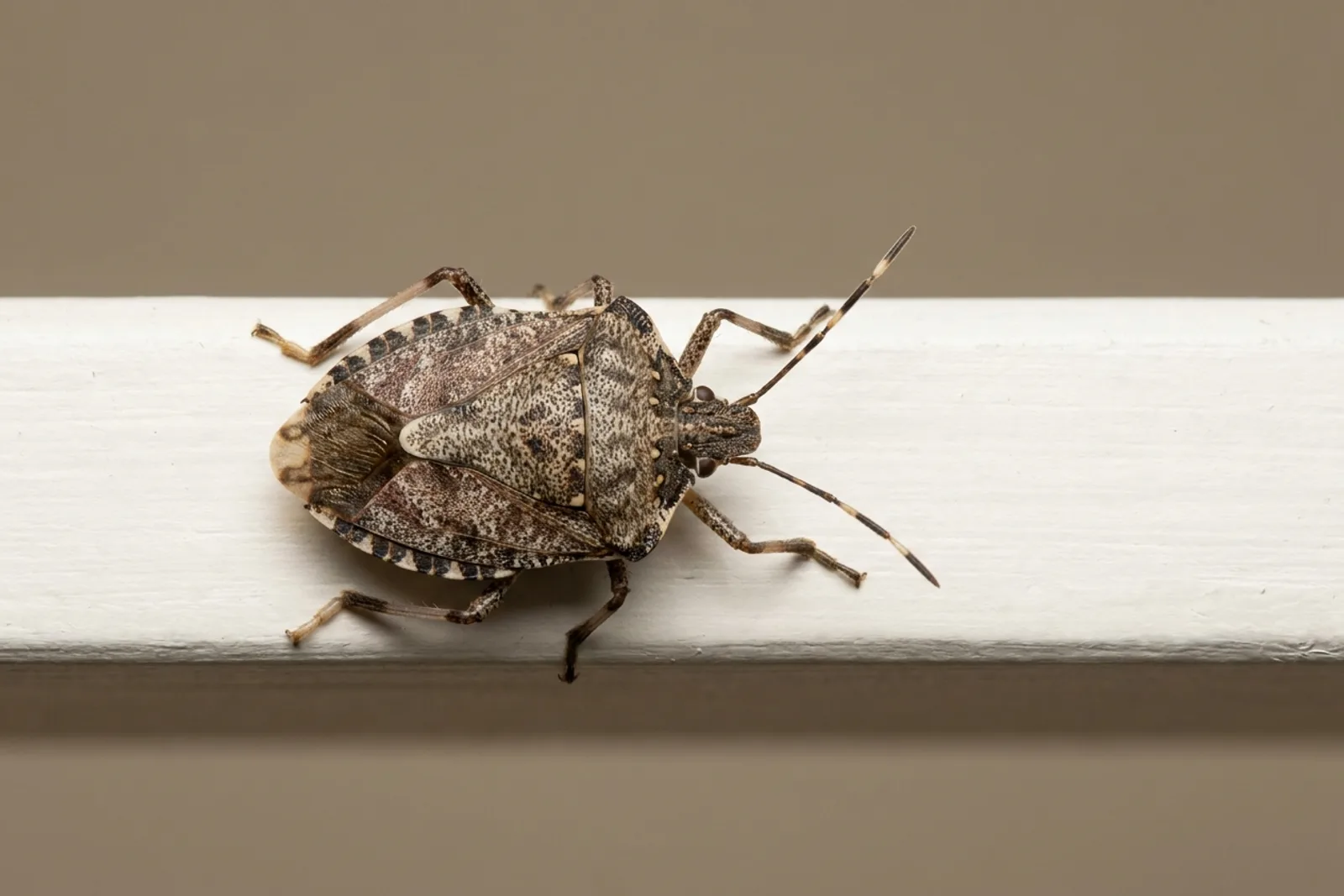
AI-generated reference image, reviewed against field photographs by Spain Pest Guide.
Short answer: the shield-shaped brown insects appearing on your Spanish windowsills each October are almost certainly brown marmorated stink bugs (Halyomorpha halys), an invasive Asian species confirmed in Catalonia since 2016. They do not bite, do not breed indoors and do no damage to the house. They are looking for a frost-free place to sleep until spring. Do not crush them, and they will not smell.
What Is Actually Coming Into Your House
Two insects account for nearly every “stink bug in house” complaint in Spain, and it is worth knowing which one you have.
Brown marmorated stink bug (Halyomorpha halys). Shield-shaped, 12 to 17 mm, mottled brown, and identifiable by two features nothing native shares: alternating pale and dark bands on the last two antennal segments, and alternating light and dark banding on the exposed edge of the abdomen where it juts out beyond the folded wings. Its shoulders are smooth rather than toothed. This is the one that gathers in numbers, flies clumsily into rooms at dusk and ends up behind curtains.
Green shield bug (Palomena prasina). Bright green through summer, then turning a dull bronze-brown in autumn before it overwinters, which is why so many people report a “green stink bug that changed colour”. It is native, harmless, a mild garden nuisance at worst, and it comes indoors in ones and twos rather than dozens.
Both are true bugs of the family Pentatomidae. Both smell when squashed. Only the marmorated one is an agricultural problem.
What your Spanish neighbours call it
Ask about it locally and you will hear chinche apestosa or chinche verde hedionda, and in the Ebro fruit-growing valleys the specific chinche marrón marmorada. Note that chinche alone usually means a bed bug, so be precise: chinche apestosa if you want the right answer from a ferretería.
Why They Come Indoors Every October
Stink bugs do not want your kitchen. They want a crevice that will not freeze.
Halyomorpha halys passes the winter as an adult in diapause, a shutdown state where it neither feeds nor breeds. In its native China, Japan and Korea it would spend those months under loose bark or in rock cracks. In Spain it has found something better: the sun-facing wall of a modern building, warmed all afternoon, riddled with entry points.
The trigger is temperature and day length together. When night temperatures start dropping below about 15 degrees, usually the first half of October across northern and eastern Spain, adults leave orchards and gardens and start what entomologists call the aggregation flight. They pile onto the warmest, brightest wall of a building in the afternoon sun, walk until they find a gap, and go in.
The gaps they use are consistent:
- Roller shutter boxes (cajones de persiana), the single biggest entry route in Spanish housing and the reason bugs appear on the inside of an otherwise sealed window.
- Gaps between window frame and wall where old sealant has cracked.
- Vents: extractor outlets, bathroom vents and unscreened air bricks.
- The gap under an exterior door without a brush strip.
- Roof space access points, loose tiles and soffit gaps.
Once inside they head for cool, dark, undisturbed voids: the attic, the space above a suspended ceiling, behind wardrobes on an outside wall, inside the shutter box itself. You then get a second wave of appearances on warm February afternoons when heating or a mild spell tricks a few into thinking spring has arrived, and they blunder out into the living room.
Do They Bite? No, and Nothing Else Either
This is the reassuring part. Stink bugs have a stylet, a needle-like mouthpart folded under the head, and it is engineered to puncture plant tissue and drink sap. It cannot break human skin in any meaningful way, and there is no venom behind it.
They also do not:
- breed indoors (they are in diapause and will not lay eggs in your house)
- eat fabric, timber, paper or food in your cupboards
- carry any human disease
- damage wiring, insulation or plaster
The complete list of harm they do inside is: they smell, they are startling when one flies into a lampshade, and in a bad year on a rural property in Catalonia or Navarre there can be hundreds of them. That is genuinely unpleasant, but it is a nuisance problem, not a health one. It is a very different situation from cockroaches in Spain, which do contaminate food and do breed indoors.
Why They Smell, and How to Not Trigger It
Paired glands on the underside of the thorax hold a defensive cocktail, dominated by aldehydes such as trans-2-decenal. Squash the insect, trap it against skin, or alarm it badly, and it fires. People describe the result as coriander gone wrong, rancid almonds or burnt rubber, and the compounds are oily enough to cling to fingers, cloth and the inside of a vacuum cleaner for days.
Two practical consequences:
- Never crush one. A single crushed bug on a curtain will scent a room for hours and can mark pale fabric.
- Never use your household vacuum. The smell coats the filter and the motor housing, and you will smell it every time you clean for weeks afterwards.
How to Remove Them Properly
One or two bugs. Slide a sheet of card under it, cup a glass over it, walk it out to a window well away from the wall it came in on, and let it go. Or nudge it directly into a jar and screw the lid on.
A dozen or more. Half-fill a jar or a cut-off plastic bottle with water and a squirt of washing-up liquid. Hold it under the bug and tap it in from above: their escape reflex is to drop, so they fall straight into the water and the surfactant stops them climbing out. Tape the bottle to a bamboo cane for ceiling and high-window work.
A serious aggregation in an attic or shutter box. Fit a knee-high stocking inside the vacuum tube, secured with the nozzle, so the bugs collect in the stocking and never reach the machine. Pull the stocking out, tie it and bin it outside. Alternatively use a cheap handheld vacuum kept solely for this job and emptied straight into an exterior bin.
Light traps. A desk lamp aimed into a foil roasting tin of soapy water, left on in a dark room overnight, collects a surprising number for zero effort. It works because overwintering adults orient to light indoors.
What not to buy
Household insecticide sprays are close to useless here. Stink bugs entering a wall cavity are protected from residue, and dead bugs decomposing inside a shutter box or ceiling void attract carpet beetles and larder beetles, which then do eat your fabrics. Sealing beats spraying every time with overwintering insects.
Sealing: The Only Fix That Lasts
Everything above is removal. This is prevention, and it needs doing in late September, before the first cold nights.
- Service the roller shutter boxes. Fit or replace the brush seals in the slot, and seal the box lid seam inside the room with removable weatherstrip. This alone stops most incursions in Spanish flats and villas.
- Re-silicone window and door frames where the bead has shrunk or cracked, which it does fast under Spanish UV.
- Fit brush strips to the bottom of exterior doors, including the garage and the trastero.
- Screen every vent with fine stainless mesh: extractor outlets, air bricks, and the gaps under roof tiles at the eaves where accessible.
- Cut back climbing plants and shrubs touching sun-facing walls, which act as staging posts for the aggregation flight.
- Turn off or shield bright exterior lights on the warm wall during October evenings.
The same work pays off against several other autumn arrivals, which is why it is worth doing once and properly. Sealing gaps also blocks spiders and, in the south, scorpions, which use exactly the same routes in from the same walls.
The Garden and Fruit Damage Nobody Mentions
Indoors, stink bugs are an annoyance. Outdoors, Halyomorpha halys is a genuine economic pest, and this is why Spanish agricultural authorities monitor it closely.
It feeds by inserting its stylet through fruit skin and drawing out cell contents, which leaves a corky, dry, sunken patch under the surface. The fruit looks fine on the tree and is unsellable when cut. Its host list is enormous, over 100 plants, but the ones that matter in Spain are pears, apples, peaches, nectarines, kiwis, hazelnuts, tomatoes and peppers. The Ebro valley fruit belt through Lleida, Girona, Aragon and Navarre has taken the worst of it, and the Basque Country and Navarre have active monitoring programmes.
In a home garden the damage shows as pockmarked tomatoes, deformed peppers and cat-facing on stone fruit. Fine mesh over vegetable beds from midsummer is the only reliable domestic control. Spraying a home orchard does not work, because the adults simply fly back in from surrounding land.
The Calendar
| Month | What is happening |
|---|---|
| April to May | Adults leave overwintering sites, feed and mate |
| June to August | One or two generations develop on garden and orchard plants |
| September | Adults feed heavily to build fat reserves; fruit damage peaks |
| October | Aggregation flight; mass entry into buildings |
| November to January | Diapause in wall voids, attics and shutter boxes |
| February to March | Warm-day false starts; bugs appear indoors and try to leave |
If you seal in September you skip the whole of the rest of that table. If you wait until you are picking bugs off the curtains in November, you are managing the ones already inside and you will do it again next year. Check the seasonal pest calendar for what else is due at the same time.

Written by James Thornton
Founder & Lead Writer
British expat living in Málaga since 2019. Researched 200+ pest control cases across 16 Spanish regions.

Reviewed by Carlos Ruiz Martín
ROESBA-certified (Spain's Official Pest Control Registry). DDD specialist. Member of ANECPLA.
You Might Also Like
Scorpions in Spain: What to Do
The other autumn visitor that gets in through the same gaps under doors.
Damp, Mould and Pests in Spain
Why the same sealing and ventilation work that stops damp also stops overwintering insects.
Do Cockroaches Survive Winter in Spain?
What happens to Spain's indoor pests when the temperature finally drops.