
Processionary Caterpillar Season 2027: Dog Owner's Guide
When processionary caterpillar season starts in each Spanish region, the 10-minute dog emergency protocol, and what to do about a nest in your garden.

By James Thornton
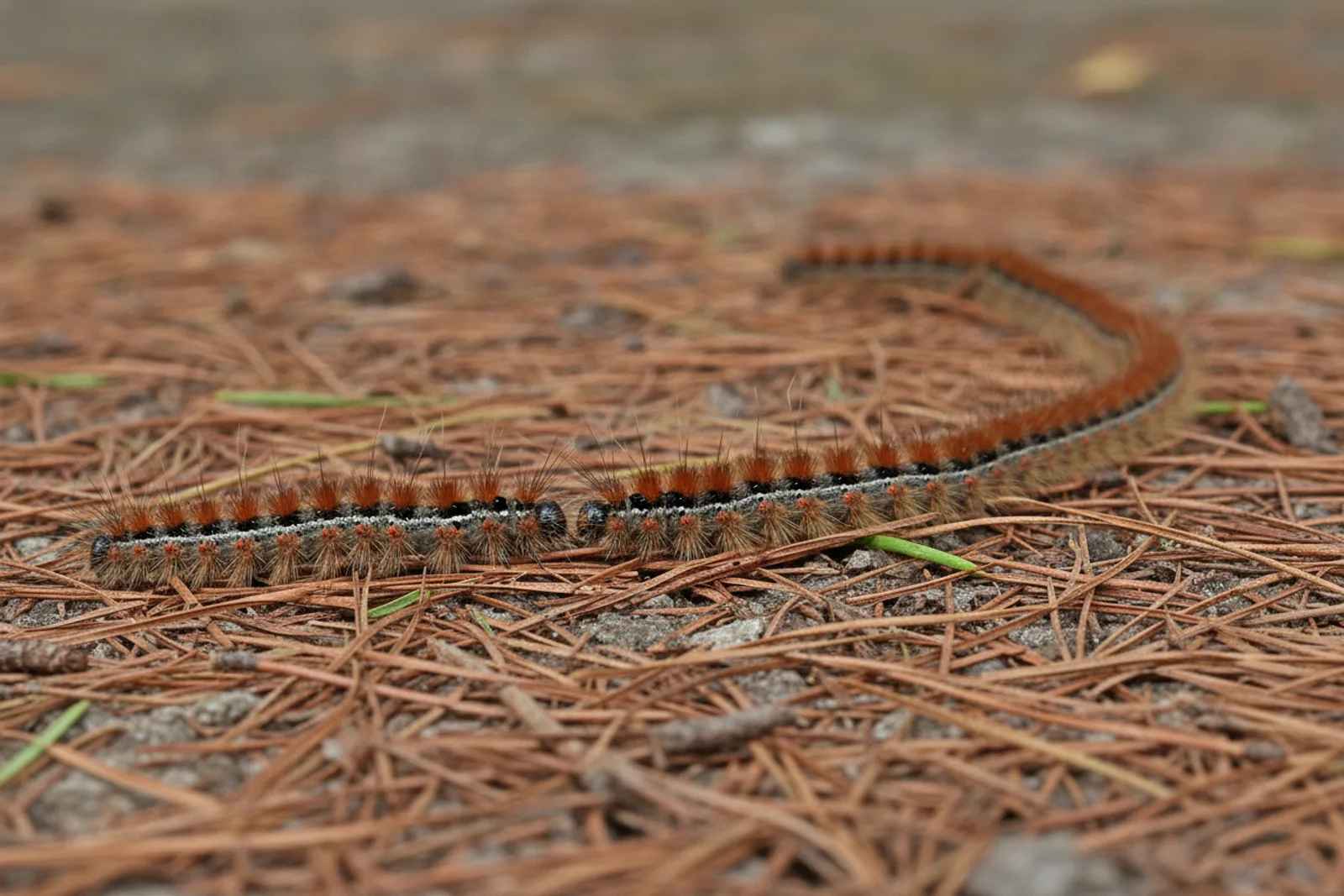
AI-generated reference image, reviewed against field photographs by Spain Pest Guide.
The 2027 processionary season starts before you see a single caterpillar. Nests of Thaumetopoea pityocampa are already forming in Spanish pines through November and December 2026, and the processions that put dogs in emergency vets begin on the southern and Mediterranean coasts in January 2027. If you own a dog and live anywhere near pines, the useful work happens in autumn, not in spring when the caterpillars are already on the ground.
This is the single worst animal in Spain for dogs. Not vipers, not scorpions, not spiders. A dog that mouths one caterpillar can lose part of its tongue within hours.
Season Calendar by Region
| Region | Nests visible | Processions on the ground | Peak dog risk |
|---|---|---|---|
| Costa del Sol, Costa Tropical, western Andalucia | November to December | Mid January to March | February |
| Costa Blanca, Murcia, Valencia | November to January | Late January to March | February to March |
| Catalonia coast, Balearics | December to January | February to April | March |
| Madrid, Castilla-La Mancha, Extremadura inland | December to January | March to April | March to April |
| Castilla y Leon, Aragon, high plateau | January | March to May | April |
| Galicia, Asturias, Cantabria, Basque Country | January to February | April to May | April to May |
Two rules move these dates. A mild winter pulls everything forward, sometimes by three or four weeks, so a warm January on the coast produces processions in the middle of the month. Altitude pushes it back: the same pine forest 800 metres higher runs a month later than the valley.
The processions themselves are what the name describes. When the soil is warm enough, the caterpillars leave the nest and travel down the trunk and across the ground in a nose-to-tail line, sometimes dozens long, looking for soft earth to bury themselves in and pupate. That line on a footpath, a firebreak or the edge of a car park is where dogs meet them.
The 10-Minute Dog Emergency Protocol
If your dog has licked, mouthed or nosed a caterpillar, its silk, or a broken nest, act on the assumption that it is serious.
- Do not touch the dog’s mouth with bare hands. The hairs transfer. Put on gloves if any are within reach.
- Rinse the mouth, tongue, lips and muzzle with plenty of lukewarm water. A bottle, a hose on gentle flow, a syringe without the needle. Let the water run out; do not force the dog to swallow.
- Do not rub, wipe or scrub anything. The hairs are barbed micro-harpoons. Friction breaks them open and drives more toxin into the tissue. This is the mistake that turns a bad case into a lost tongue.
- No vinegar, no salt, no alcohol, no oil, no milk, no home remedies. Water only.
- Do not give food or water to drink. The dog may need sedation at the clinic.
- Call the vet while someone else rinses and say the words procesionaria del pino. Every Spanish vet knows exactly what that means and will take you straight in.
- Drive. Do not wait to see whether it settles down.
Symptoms to expect: heavy sudden drooling, pawing at the mouth, a rapidly swelling tongue and lips, whining, vomiting, and in serious cases a tongue that turns pale then blue or black at the tip. That colour change is necrosis, and the necrotic section can slough away. Swelling of the throat can compromise breathing. Vets typically treat with corticosteroids, antihistamines, analgesia and fluids, and time is the main variable in whether the tongue survives.
The hairs stay dangerous after the caterpillar dies
Urticating setae remain active in an old nest, in shed skins and in the soil for months, and in a dry nest for a year or more. A dead caterpillar squashed on a path in May is still a hazard. This is why walking a dog under a pine with an old nest in July can still cause a reaction.
Children, Skin and Eyes
In people, contact produces fierce urticaria: raised weals, intense itching and burning, usually on the forearms, neck and any exposed skin, appearing within minutes to a few hours. It is not an allergy in most cases but a mechanical and toxic irritation, which is why it happens to everyone rather than only to sensitised people.
For skin: rinse with plenty of water, then lift hairs off with adhesive tape applied and pulled away repeatedly before showering. Wash clothing separately at high temperature. Do not scratch and do not rub with a towel.
For eyes: irrigate copiously with water or saline and go to an eye doctor. Hairs can migrate into the cornea and deeper structures over days and weeks, causing a condition called ophthalmia nodosa. This is the one presentation that genuinely needs specialist follow-up.
Children are the group most affected because they pick caterpillars up, and because a line of them marching in single file is fascinating. The single most effective piece of parenting here is naming it: show them what a nest and a procession look like in January, and say clearly that these are the ones you never touch.
What the Ayuntamiento Does
Most councils in Spanish pine regions run a treatment programme on public land, and the calendar is worth knowing because it tells you when the risk is being managed and when it is not.
- September to November: aerial or drone application of Bacillus thuringiensis var. kurstaki over municipal pine stands, targeting young larvae before nests are built. This is the cheapest and most effective moment in the whole cycle.
- October to November: trap collars fitted to pines in parks, schools and campsites. These are plastic collars with a sealed chute that intercepts the caterpillars as they descend the trunk and funnels them into a bag of soil. They are highly effective on individual valuable trees and are the best option for a private garden.
- October to December: endotherapy, injection of insecticide into the trunk, on high-value or high-traffic trees where spraying is not practical.
- December to February: manual nest removal by climbers, and pheromone trap deployment for the adult moths in summer.
Trees on private land are the owner’s problem, not the council’s. In an urbanisation, the pines on communal ground are the comunidad de propietarios’ responsibility, and this is worth raising at the autumn junta rather than in February when nests are already mature.
Report affected public trees through the ayuntamiento’s sede electrónica or the council app, with a photo and the location. Councils act on reports, and a nest over a school route or a dog-walking path gets priority.
A Nest in Your Own Garden
If you have a pine on your plot with a white silk bag in it, you have until roughly January to deal with it cleanly.
Best option, autumn: fit a trap collar in October or early November, before the caterpillars descend. Nothing else is as safe, because the caterpillars end up sealed in a bag rather than airborne.
Second option, winter: cut the nest out. Only if it is low enough to reach from the ground or a stable ladder, only with goggles, an FFP2 mask, gloves and sealed sleeves, and only on a cold, still morning when the caterpillars are inside the nest. Cut the whole branch, drop it directly into a heavy sealed bag, and take it away. Shower afterwards and wash the clothes hot.
Never do this: burn the nest, shoot at it, blast it with a hose, or knock it down with a pole. Every one of those methods disperses millions of urticating hairs into the air over the whole garden, and burning is the worst of them. It is also the single most common way a Spanish gardener ends up in urgencias.
High nests: call a professional or ask the ayuntamiento whether they will act. A nest 12 metres up a mature pine is not a ladder job.
Prevention Kit
The Short Version for 2027
Between January and April, keep the dog on a lead anywhere near pines, walk in the middle of paths rather than the edges, look at the ground before you let a dog sniff at the base of a pine, and check the trees for white silk bags on every walk you repeat. If your route has nests, change your route.
The full biology, nest identification and treatment options are in the processionary caterpillars in Spain guide. For how this species compares with everything else that can hurt a dog or a person here, see dangerous animals in Spain, where it ranks first for canine emergencies. And if the problem on your walks is the other seasonal dog parasite, the ticks in Spain guide covers correct removal.

Written by James Thornton
Founder & Lead Writer
British expat living in Málaga since 2019. Researched 200+ pest control cases across 16 Spanish regions.

Reviewed by Carlos Ruiz Martín
ROESBA-certified (Spain's Official Pest Control Registry). DDD specialist. Member of ANECPLA.
You Might Also Like
Processionary Caterpillars in Spain
The complete guide – biology, nests, treatment windows and first aid for people and dogs.
Dangerous Animals in Spain
Every dangerous animal in Spain ranked by real injuries, with the caterpillar near the top for dogs.
Ticks in Spain
The other outdoor parasite that hits Spanish dogs hardest, and how to remove one properly.