
Rats in Spain: Why October Moves Them Into Your Roof
October is when roof rats move indoors across Spain. How to tell rat from mouse, the 8 entry points on a villa, and what a desratización really costs.

By James Thornton
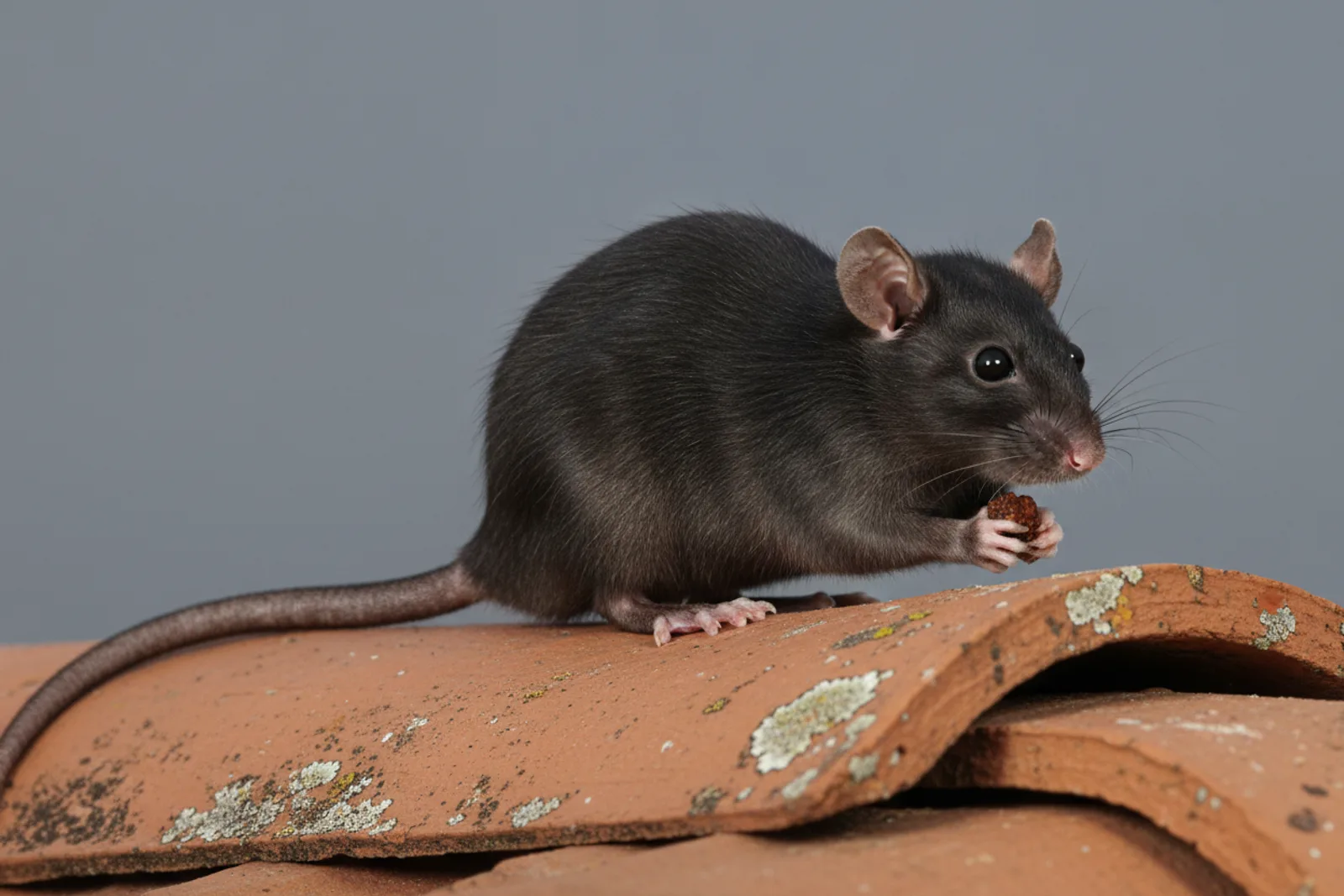
AI-generated reference image, reviewed against field photographs by Spain Pest Guide.
October is the month rats move in. Across Spain, the first cool nights, the autumn rains and the end of the irrigation season push Rattus rattus out of the drains, dry riverbeds and palm crowns and into roof voids, garages and pool pump rooms. If you have never had a rodent problem in your Spanish home, this is the month you are most likely to get one.
The trigger is simple. Rats stay outdoors while nights are warm and food is abundant. Once night temperatures on the coast settle below about 15°C, usually in the first half of October, the maths flips: your roof is warmer, drier and safer than anywhere outside, and it is a short climb up a downpipe or a bougainvillea.
Roof Rat, Sewer Rat or Mouse?
Spain has two rat species and one common house mouse, and they behave completely differently.
Rattus rattus, the black or roof rat, is the one in Spanish houses. Slim body, tail longer than the body, large ears, an outstanding climber. It lives above you: false ceilings, roof voids, terrace pergolas, and famously the crowns of palm trees, which is why Spaniards call it the rata de palmera.
Rattus norvegicus, the brown or sewer rat, is heavier and blunter, with a tail shorter than its body. It stays low: sewers, drains, basements, compost, chicken runs.
Mus musculus, the house mouse, is 7 to 10 cm of body and needs a gap the width of a pencil to get in.
| Sign | Mouse | Roof rat |
|---|---|---|
| Droppings | 3 to 6 mm, thin, pointed, scattered widely | 12 to 18 mm, thick, blunt, in defined latrine spots |
| Sound | Light, fast scratching inside walls, mostly at night | Heavy thump and drag across the ceiling, running at dusk and dawn |
| Damage | Fine scratch marks, shredded paper and fabric nests | Wide gnaw grooves, chewed cable insulation, damaged irrigation pipe |
| Location | Kitchen units, behind appliances, under floors | Roof void, false ceiling, garage rafters, pump room |
| Grease marks | Faint | Dark smears along beams and pipe runs |
| Food evidence | Nibbles across many items | Fruit taken whole, avocados and citrus hollowed out |
The single most reliable test is a dropping. If you find something the size of a rice grain, you have mice. If it is the size of an olive stone, you have a rat, and you should assume it is in the roof.
The 8 Entry Points on a Spanish Property
Rodent control in Spain is proofing work first and trapping second. On almost every villa and apartment block, the way in is one of these:
- The downpipe and the roof edge. Roof rats climb rendered walls and drainpipes easily and enter under loose teja tiles at the eaves.
- Unscreened roof and soffit vents. Standard ventilation grilles in Spanish builds are often plastic and quickly chewed through.
- Air conditioning penetrations. The hole drilled for the refrigerant line and condensate pipe is almost never sealed properly.
- The pool pump room. Warm, sheltered, usually with an open service duct straight to the garden and often left ajar.
- Garage doors. The rubber seal under a sectional garage door wears and leaves a 2 to 3 cm gap along the whole width.
- Drains and unused waste pipes. A disused washing machine outlet or a dry, untrapped floor drain is a clean route from the sewer.
- Palms, bougainvillea and jasmine touching the building. A branch against the wall is a ladder. Cut back anything within a metre of the facade.
- The communal rubbish room and the meter cupboard in apartment blocks, then along service risers into individual flats.
Fix the gaps with steel wool packed tight then sealed with expanding foam, or with galvanised mesh of 6 mm or finer. Foam alone is chewed through in a night. Rats gnaw through plastic, silicone, wood and soft mortar, but not stainless mesh or steel wool.
Snap Traps or Bait Stations?
For a household problem inside your own home, snap traps are the better first move. They kill fast, they confirm the species, and there is no poisoned rodent dying inside a wall cavity, which is a smell you will live with for three weeks.
Set them along walls and beams, not in the open, with the trigger end facing the wall. Bait with peanut butter, chorizo or chocolate spread, not cheese. Rats are neophobic: they avoid new objects for several days, so set traps unset and baited for two or three nights first, let them feed, then arm them. Mice are the opposite and will investigate a new trap the same night.
Rodenticide in Spain is regulated. Professional anticoagulant baits are restricted to certified applicators, and consumer products sold for home use must be deployed inside a lockable, tamper-resistant bait station. That rule exists for a reason: secondary poisoning of dogs, cats and owls is the main harm from amateur rodent control. If you have pets or children, use enclosed stations or skip poison entirely and trap.
Ultrasonic repellers do not work
Independent trials have consistently failed to show any lasting reduction in rodent activity from ultrasonic devices. Rats habituate within days, and ultrasound does not pass through walls, insulation or furniture, so the roof void where the animals actually live is acoustically shadowed anyway. Spend the money on mesh and traps.
Signs You Have One Before You See One
You will almost never see a roof rat. They are nocturnal, cautious and fast, and by the time one crosses a lit kitchen floor the population is well established. What you get instead are the indirect signs, and in a Spanish house they show up in a predictable order.
First comes the noise: a heavy scuttle across the false ceiling shortly after dark, or a drag and thump above the bedroom at about four in the morning. Second, droppings in defined spots, usually in the roof void beside a beam or on top of the water tank. Third, grease marks, dark smears where an oily flank has repeatedly brushed the same beam or pipe run. Fourth, gnawing: chewed irrigation pipe in the garden, stripped cable insulation, a hole in a bag of dog food, corners taken off wooden roof battens.
The two that get missed are fruit damage and smell. A roof rat will hollow out oranges, avocados and figs on the tree and leave the skin hanging, which many owners blame on birds. And a rat colony in an enclosed void develops an ammonia odour that is distinct from damp: sharp, sour and strongest on warm afternoons when the roof heats up.
Act on the first sign, not the third. A pair of roof rats in October becomes a dozen by January, because they breed year-round once they are inside a warm building and are no longer limited by winter weather.
What to Buy
Who Is Responsible: You, the Comunidad, or the Ayuntamiento?
This is the question that decides whether you pay.
Your flat or house interior: yours. You proof it and you treat it.
Shared areas of a building – the garage, the roof, the patio, the rubbish room, the communal drains, the risers – are the comunidad de propietarios’ responsibility. Report it in writing to the administrador de fincas, ask for it to go on the next junta agenda, and ask specifically for a desratización contract rather than a one-off visit. One treated flat in an infested block is wasted money.
The public sewer, the street, parks and municipal land are the ayuntamiento’s. Most Spanish councils run a free desratización programme and take reports by phone, by app or through the sede electrónica. If rats are coming up from a street drain outside your gate, report it there and do it in writing so there is a record.
What a Desratización Costs in Spain
| Job | Typical price |
|---|---|
| Flat or small house, initial visit plus one follow-up | 90 to 200 euros |
| Villa with garden, roof void and outbuildings | 250 to 450 euros |
| Roof void infestation including proofing work | 350 to 600 euros |
| Communal building, annual maintenance contract | Quoted per building, commonly 400 to 1,200 euros a year |
| Ayuntamiento sewer treatment | Free on request |
Prices vary by province and are usually higher on the islands. Ask any company for their número de registro ROESB, the official biocide applicators register, before booking. Anyone treating with professional rodenticide must hold it. The pest control companies in Spain guide covers how to check and what a proper quote includes.
The October Checklist
- Walk the roof line and the eaves before the rains and re-bed any loose tiles.
- Mesh every vent and the air conditioning penetration.
- Cut back palms and climbers to a metre clear of the walls.
- Fit or replace the garage door seal.
- Cap or trap any disused waste pipe.
- Clear fallen fruit weekly. A carob, fig or citrus tree is a rat feeding station.
- Move pet food and birdseed into sealed containers, not the original bags.
- Put two snap traps in the roof void as sentinels, baited but unset, and check them weekly.
Rodents move indoors on a schedule, and October is that schedule. Proof the building in September and the problem never starts. Full species detail, trap placement and bait choice are in the rats and mice in Spain guide, and if you are unsure what is active this month, the seasonal pest calendar lays out the year.
One more overlap worth knowing: the damp roof voids and leaking pipes that attract rodents in autumn are the same conditions behind mould and cockroach activity, covered in damp, mould and pests in Spain.

Written by James Thornton
Founder & Lead Writer
British expat living in Málaga since 2019. Researched 200+ pest control cases across 16 Spanish regions.

Reviewed by Carlos Ruiz Martín
ROESBA-certified (Spain's Official Pest Control Registry). DDD specialist. Member of ANECPLA.
You Might Also Like
Rats and Mice in Spain
The full guide to Spanish rodents – species, signs, traps, baits and proofing.
Damp, Mould and Pests in Spain
Why the same conditions that grow mould also feed rodents and cockroaches.
Can Cockroaches Survive Winter in Spain?
Where cockroaches go in Spanish winters and why cold months are your prevention window.